
What the 2026 Point-in-Time Count Shows and How RMHS Programs Support Housing Stability
September 25, 2026

New data from the Denver metro area and El Paso County shows fewer people experiencing homelessness, while highlighting the value of coordinated housing and supportive services.
Results from the 2026 Point-In-Time (PIT) Count show fewer people experiencing homelessness in both the seven-county Denver metro area and El Paso County compared with 2025 results.
The PIT Count provides a one-night snapshot of sheltered and unsheltered homelessness. When considered alongside Colorado’s 2025 State of Homelessness Report, which examines data collected throughout the year, the findings offer a broader look at housing stability and the systems working to prevent and resolve homelessness.
They also provide context for the work of RMHS programs like INCLUDE, Homes for All Veterans, and Mission Supports. These programs help people navigate housing and service systems, access benefits and resources, and work toward long-term stability.
What is the Point-in-Time Count?
Each January, communities across the country conduct the federally required PIT Count to estimate the number of people experiencing homelessness on a single night. Outreach teams and volunteers visit emergency shelters and other locations to count people living in both sheltered and unsheltered settings.
In the Denver area, the count was coordinated by the Metro Denver Homeless Initiative (MDHI) and took place on the night of January 26- 27, when temperatures dropped to a low of -6°F. In Colorado Springs, the Pikes Peak Continuum of Care (PPCoC) conducted its count on the night of January 24-25, when temperatures reached a low of -9°F.
The extreme cold provides important context for interpreting the counts, as people may have been more likely to seek shelter and less likely to remain outdoors. Both communities activated cold-weather shelters during the count.
Denver Metro PIT Count Shows Decrease in Homelessness
The 2026 PIT Count results showed 9,950 people experiencing homelessness in the seven-county Denver Metro area, an 8 percent decrease from 2025’s count of 10,774 individuals. This is the largest year-over-year reduction in homelessness in the last decade.
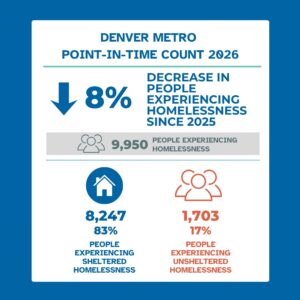
Key findings from the PIT Count in Denver Metro include:
- Fewer people were counted in unsheltered settings. Approximately 17% of people included in the count were unsheltered, meaning living in cars, tents or other places not intended for habitation. This is a 21% reduction from the number of people unsheltered in 2025, going from 2,149 to 1,703.
- The number of both individuals and families experiencing homelessness decreased. This indicates reductions across multiple household types.
- Most people counted were staying in sheltered settings. Approximately 83% were in emergency shelters, transitional housing or other sheltered locations.
MDHI attributes the regional decrease to investments in housing, supportive services, prevention and coordination among local governments, service providers and community partners.
The companion 2025 State of Homelessness Report also found that more than half of people experiencing homelessness reported living with a disabling condition. This underscores the role of housing and supportive services that can respond to a range of individual needs.
At RMHS, Mission Supports and INCLUDE serve people with intellectual and developmental disabilities (I/DD) who are experiencing or at risk of homelessness in the Denver area. Although the programs serve overlapping populations, each provides a distinct type of support.
Mission Supports connects people with disability services and resources
Mission Supports helps people with I/DD who are experiencing housing instability navigate systems that can otherwise be difficult to access. Depending on a person’s circumstances, the program may help with obtaining an I/DD determination, applying for benefits, connecting with case management and disability services, and connecting them with housing and community resources.
The program notes that many of the people it serves would not necessarily be captured in a traditional PIT Count. Some are temporarily staying with friends or relatives, living in hotels, or moving between temporary housing situations. Others may be incarcerated and have no housing available once they’re released.
“Much of the housing instability for those served by Mission Supports comes from having limited or no income along with the stress and exhaustion of not being able to meet many of their own daily living needs independently,” said Arnie Swenson, Associate Director of Mission Supports.
Mission Supports has also seen an increasing number of referrals from Denver County and Denver District competency-related court programs. These programs connect people involved in the criminal legal system who have competency concerns with community-based treatment and support services. For Mission Supports, these referrals demonstrate how disability, behavioral health, housing instability and involvement with other systems can intersect.
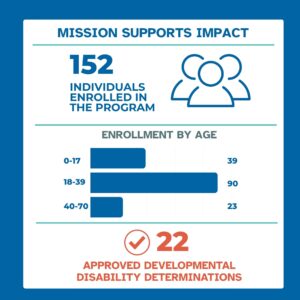
Over the past year, Mission Supports has enrolled 152 individuals and helped 22 people complete an approved developmental disability determination. Obtaining a formal I/DD determination is an important step toward accessing the services that support greater independence and long-term stability.
For one young participant, that process involved coordination across several community organizations. After arriving at a shelter without stable housing, the participant connected with Mission Supports as well as Servicios de La Raza’s STAR program, and Easterseals’ Disability Benefits System program.
Within a year of collaborative support, the participant transitioned to an approved Developmental Disabilities waiver-funded host home, gained stable housing, and began receiving Supplemental Security Income (SSI).
Stories like this illustrate why addressing homelessness often requires more than providing a bed or a housing placement. For some people, identifying an underlying disability, navigating complex benefit and service systems, and connecting someone with the right combination of housing and ongoing supports may all be part of creating a sustainable path forward.
INCLUDE combines housing support with long-term service coordination
INCLUDE supports Denver-area residents with I/DD who are experiencing homelessness or housing insecurity. The program brings housing-focused services together with RMHS’ experience in benefits navigation, Medicaid waiver access, and long-term service coordination.
Depending on a person’s needs and eligibility, INCLUDE may provide:
- Housing navigation and stabilization
- Rapid rehousing support
- Benefits and Medicaid waiver enrollment assistance
- Navigation of rental or utility assistance
- Connections to healthcare, employment and community resources
- Long-term service coordination
By combining immediate housing assistance with connections to ongoing I/DD services, INCLUDE helps participants address current housing needs while also building longer-term support.
El Paso County PIT Count also identifies a decrease
Further south, the Pikes Peak Continuum of Care (PPCoC) conducted its 2026 PIT Count on January 24 during a notably cold night.
Despite the cold that likely affected the number of people sleeping outside, the 2026 count found 1,413 people experiencing homelessness in El Paso County, a 19% decrease from 2025, when the region recorded its highest PIT Count total of all time.
Of those counted this year, 308 people were unsheltered, while 1,105 were staying in emergency shelters, transitional housing, or safe havens.
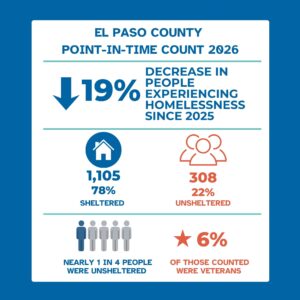
Key findings from the PIT Count in El Paso County:
- Close to one in four people counted were unsheltered. This includes people living outside, in vehicles or in abandoned buildings
- Veterans represented approximately 6% of people included in the count. Statewide, veteran homelessness decreased by 2.9% in 2025, according to the State of Homelessness Report.
The PIT Count provides one snapshot of veteran homelessness. Through year-round outreach, prevention assistance, case management and housing support, staff from Homes for All Veterans (HAV) see the different circumstances that may place veterans at risk of losing housing or make it difficult to regain stability.
Homes for All Veterans provides both homelessness prevention and housing support
Homes for All Veterans (HAV) serves veterans experiencing or at risk of homelessness throughout Colorado. The program assists veterans who are actively seeking housing while also providing prevention services to help veterans remain housed.
“We don’t just help veterans experiencing homelessness, we try to keep folks from becoming homeless in the first place,” explains HAV Veteran Support Specialist, JT Teisher.
That prevention work is paired with an outreach-first approach designed to connect with veterans who may not seek services on their own. Teisher, who has participated in several PIT Counts over the years, describes the importance of meeting veterans where they are, building trust and keeping the door open until they are ready to accept help.
HAV and the U.S. Department of Veterans Affairs (VA) have also seen an increase in the number of veterans experiencing homelessness who are over age 60. HAV Program Manager Dee Drake says this may be connected to the challenges older veterans face in maintaining an income.
“We believe that is related to older veterans being on fixed incomes with Social Security and increased healthcare issues that make it impossible for them to work to supplement their income,” Drake explained.
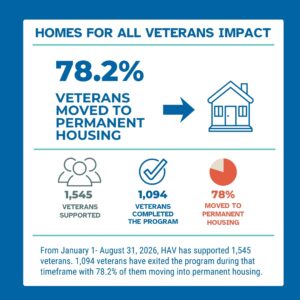
Between January 1 and August 31, 2026, HAV has supported 1,545 veterans. Of the 1,094 participants who have exited the program in this timeframe, 78% moved into permanent housing, which reflects the impact of HAV’s ongoing work.
Turning information into support
The PIT Count and State of Homelessness Report measure different aspects of homelessness and housing stability. Together, they show measurable regional progress while also identifying the continued need for affordable housing, prevention services, and individualized support.
RMHS programs respond to that need in different ways. Mission Supports connects people with I/DD to disability determinations, benefits, and services. INCLUDE combines housing navigation and stabilization with long-term I/DD service coordination. Homes for All Veterans helps veterans obtain or maintain stable housing.
RMHS has created a Front Range Affordable Housing Providers Guide to support those in the Denver area seeking affordable housing. Please consider sharing it with individuals, families, and community partners who may find it helpful.
Connect with RMHS programs
If you or someone you know is a veteran experiencing housing instability in Colorado, contact Homes for All Veterans at HAVreferrals@rmhumanservices.org or visit www.rmhumanservices.org/homes-for-all-veterans.
For support connecting a Denver resident with a possible I/DD to disability services, benefits and other resources, contact Mission Supports at missionsupports@rmhumanservices.org or visit www.rmhumanservices.org/mission-supports.
For housing navigation, stabilization, and long-term service coordination for a Denver-area resident with I/DD experiencing homelessness or housing insecurity, contact INCLUDE at include@rmhumanservices.org or visit www.rmhumanservices.org/the-include-program.