
Who Makes Decisions — and How the Pieces Fit Together
March 25, 2026
Colorado’s long-term services and supports system is complex. It is shaped by federal law, state policy, funding decisions, and the work of many organizations across the state. This series is designed to help explain how the system works, where decisions originate, and how organizations like Rocky Mountain Human Services help individuals and families navigate it.
Part of the “Understanding Colorado’s Long-Term Care System” series
By Amy Becerra, RMHS Chief Strategy Officer
As someone who has spent years working inside this system, I’ve seen how confusing it can feel from the outside. Over the coming months, we’ll be sharing a series of articles designed to bring a little more clarity to Colorado’s long-term services and supports system.
For individuals receiving services, families supporting a loved one, and even professionals working in this field, the system can sometimes feel difficult to understand — especially when someone is newly seeking services or when policy or funding changes affect the programs people rely on.
When that happens, it’s natural to ask questions like:
Who decided this?
Why did this change?
How does this system actually work?
Those are reasonable questions.
Over the years, I’ve learned that much of the frustration people experience comes from not knowing how the pieces of the system fit together. Often, the people families interact with most directly are local case managers who are helping implement decisions made elsewhere.
This article is intended to provide a clearer picture of how the system is structured and where different kinds of decisions originate.
The Foundation: Medicaid
Most long-term services in Colorado are funded through Medicaid.
Medicaid is a partnership between the federal government and the state that provides health coverage for many vulnerable populations. The federal government sets broad requirements and provides a portion of the funding. Each state then designs and administers its own program within those federal parameters.
Colorado documents how it operates Medicaid in what is called the “State Plan.” That document outlines what services are covered through Health First Colorado (Colorado’s state Medicaid program), who is eligible, and how the program functions. Over time, that plan has been amended and updated through legislation, budget adjustments, and administrative changes. Medicaid is not static. It evolves as policies shift, funding priorities change, and public expectations continue to develop.
Where Long-Term Care Fits
Long-term care has always been part of Medicaid’s design. In fact, nursing facility care is a required benefit under federal law. Every state must provide it. The reason being: long-term care is extremely expensive, and most families cannot afford extended institutional care on their own. Medicaid became the primary safety net for those needs.
For many years, long-term care in this country primarily meant nursing facilities and other institutional settings. Individuals with significant disabilities were often placed in facilities, sometimes for their entire lives.
Over time, people began asking an important question: with the right supports, could individuals live in their homes and communities instead?
That shift in thinking changed public policy. States began applying for Medicaid waivers that allowed them to provide home and community-based services (HCBS)—supports that help people receive care in their homes and communities rather than in institutions. These services sit alongside the traditional Medicaid State Plan and created new pathways for people with disabilities to live in their communities.
The system we operate today grew out of that movement toward dignity, independence, and inclusion. We’ll explore that history in more depth in a future article in this series.
The Layers of Decision-Making
One reason the system can feel confusing is because responsibility is shared across several levels of government and organizations. The people that families interact with the most often are not the ones making policy or finding decisions.
Because Medicaid is a federal–state partnership, authority flows through several levels. In general, decisions move from federal law to state policy to local implementation.
One way to understand how the system works is to picture the layers of decision-making from the top to bottom.
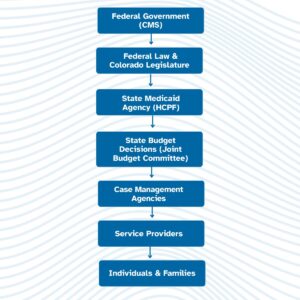
This structure is simplified, but it illustrates an important point: decisions about policy and funding often originate at the federal or state level, while the day‑to‑day experience of the system happens closest to individuals and families.
Here’s a closer look at the roles each layer plays:
Federal Level
- Federal Government (CMS)
Establishes Medicaid laws and regulations and shares funding with states. Federal rules create the framework within which every state must operate.
State Level
- Colorado Legislature
Passes state laws that shape Medicaid programs, eligibility rules, and how services are organized in Colorado.
- Joint Budget Committee (JBC)
Determines how much funding Medicaid programs receive each year. Budget decisions made here directly affect program capacity and scope.
- Colorado Department of Health Care Policy & Financing (HCPF)
Administers Medicaid in Colorado. The department writes rules, submits updates to the State Plan, applies for and manages approved Medicaid waiver programs, and provides operational guidance to partners across the state.
Local & Community Level
- Counties
Conducts disability and financial eligibility determinations for certain programs and manages administrative responsibilities.
- Case Management Agencies (CMAs)
The main point of contact for individuals seeking long‑term services and supports. CMAs assess whether someone meets the level of need required for home and community‑based services. They also conduct I/DD determinations using state‑defined criteria, assess individual needs, develop person‑centered service plans, coordinate supports, and help individuals and families navigate the services available to them.
- Providers
Deliver the direct services individuals rely on every day so they can live in their homes and communities rather than in institutions.
No single organization runs the whole system. Different parts of the system are responsible for different pieces.
How Changes Move Through the System
When policies or funding levels change, those decisions usually begin at the federal or state level.
A new law may pass. A budget adjustment may occur. A rule may be revised.
Once those decisions are finalized, they move through the system. State agencies issue guidance, funding levels are set, and organizations across the state begin implementing the changes.
That is why changes can sometimes feel local, even when they originated elsewhere. Implementation happens closest to the individuals and families who are affected.
For individuals receiving services, those changes are often experienced through the people they interact with most directly.
Because case managers are often the primary point of contact for individuals and families, Case Management Agencies (CMAs) play an important role in helping people understand what these system changes mean in practice.
When policies shift or funding changes affect services, individuals rarely experience those changes through legislation, regulations, or budget documents. They experience them through conversations with their case managers and through the real-world impact on the services they rely on.
At the individual and family level, organizations like Rocky Mountain Human Services help people interpret new policies, apply eligibility standards defined at the state level, and coordinate services within the funding that has been allocated.
Case managers help translate changes into practical next steps, answer questions, and work with individuals and families to understand what options remain available.
Our role is not simply administrative. It is to help people navigate a complicated system, connect them with the services they rely on, and work with providers and families to maintain stability whenever possible.
We also participate in broader policy conversations whenever we have the opportunity. When we can share what we are seeing on the ground or advocate for the individuals and families we serve, we do.
While the overall structure of the system is shaped by federal and state policy, organizations like Rocky Mountain Human Services work every day to help individuals and families navigate it with clarity, stability, and care.
Why Understanding the System Matters
Colorado’s long‑term services and supports system is shaped by federal law, state policy, funding decisions, and real human lives. It has evolved over decades and continues to change as needs, policies, and resources shift.
Understanding how the system is structured does not eliminate challenges, but it does provide context.
When we understand where decisions are made, how funding moves, and why changes travel through the system the way they do, we are better prepared to respond and participate in the conversations about what comes next.
This article is the first in a series designed to build that shared understanding. In upcoming articles, we will explore:
- The history of deinstitutionalization and community-based services
- How Medicaid funding and appropriations work
- What happens when policies change
- The role of case management in greater depth
At the center of all of this are individuals and families. Through this series, we hope to make the system easier to understand for the people who rely on it and the professionals who help support them every day.