Four Years of Denver START: From Pilot Program to Community-Wide Connections
September 23, 2026
Denver START’s four-year evolution is the story of a program that began by building a new crisis-response service and has grown into a clinical resource, training partner and connector across Denver’s behavioral health and I/DD systems.
Four years ago, Denver START, a program of Rocky Mountain Human Services (RMHS), was a pilot program asking a big question: What would it take to better support people with intellectual and developmental disabilities (I/DD) who are also experiencing mental health challenges?
Four years later, Denver START has become much more than a crisis response program. Through direct services, community training, clinical consultation and partnerships, the team is helping build a broader network of support for people with I/DD and mental health needs.
We sat down with Denver START Associate Director, Mariam Alami, to look back at where the program started, what the team has learned, and where it’s headed next.
Ready, Set, START: Denver START Four Years Ago
People with I/DD and co-occurring mental health vulnerabilities often navigate systems that were not designed with both needs in mind. Mental health symptoms may look different in someone with I/DD, and without an understanding of that intersection, symptoms can be misunderstood, overlooked, or attributed solely to a person’s disability.
This can lead to what is known as diagnostic overshadowing, a phenomenon when signs of a mental health condition are mistakenly attributed to a person’s I/DD rather than recognized as a separate, treatable concern.
At the same time, many providers do not have specialized expertise in the intersection of I/DD and mental health. When preventative support is limited, care can become crisis-driven, and someone may not receive the right support until a situation has escalated to the point of involving emergency departments, law enforcement, or other emergency systems.
For individuals and families, that can mean repeated crises and navigating multiple systems without a clear, coordinated path forward.
Denver START was created to help change that.
While the START model, which stands for Systemic, Therapeutic, Assessment, Resources and Treatment, was new to Denver, it had already been implemented in communities across the country as a lifespan service designed to support people with I/DD and mental health needs.
In its first months, before its official launch in September 2022, the team was focused on questions that were critical to establishing the service: How should the on-call system work? How should the team respond to crises? How could the program build relationships with providers and other systems that support people with I/DD?
The development of Denver START continued over the next several years as it decreased client crises and helped people remain successfully supported within their communities.
In January 2025, a little more than three years after its launch, Denver START achieved national certification through the National Center for START Services (NCSS), marking an important transition from a pilot program to an established, nationally recognized service with significant autonomy.
The graphic below offers a snapshot of Denver START’s impact on the community, both in its direct services and its role in the broader community.
Four Years of Denver START: By the Numbers
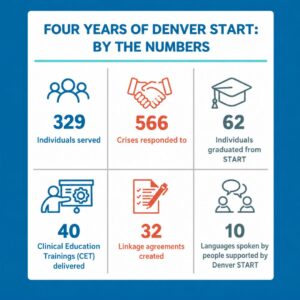
The numbers demonstrate the program’s growth. But according to Denver START’s Associate Director, Mariam Alami, the most significant change wasn’t simply how many people Denver START serves. Instead, it’s how many people and systems now know they can turn to or partner with Denver START for support.
What START Support Can Look Like
One person START has supported is J, a 25-year-old woman experiencing unpredictable seizures who felt confined at home and concerned about her physical health. Constant family supervision had led to increasing tension at home, particularly around exercise.
Recognizing a shared desire for greater independence, J and her mother agreed to participate in START therapeutic coaching with the goals of building J’s autonomy, improving her physical fitness, exploring employment opportunities, and creating healthier, more open family communication.
J took the initiative to secure a local gym membership and began taking neighborhood walks on her own, building the confidence to have more open conversations with her mother about her independence. She also began volunteering with an organization supporting people with disabilities. As the coaching process progressed, J’s mother was able to step back and give J more space to express her feelings and make decisions for herself. The experience helped J move from feeling stuck at home toward greater independence and a more active role in shaping her personal and professional future.
From Crisis Response to Community Capacity
Responding effectively when a crisis occurs remains an important part of Denver START’s work. But over four years, the team has increasingly focused on another part of the START model: strengthening the community around the people it serves.
Behavioral health providers, I/DD professionals, educators, law enforcement, emergency responders and other community partners each bring different expertise and responsibilities. Denver START helps connect those pieces through training, consultation and formal partnerships, known within the START model as linkages.
Early on, the team wasn’t sure how much demand there would be for specialized education at the intersection of I/DD and mental health. They quickly discovered significant interest across multiple systems.
“We found in speaking with behavioral health providers, police officers, and emergency department staff that these really big systems have tons of interest to support within the I/DD scope,” Alami shared. “This has been a nice learning lesson for us that our work is valuable across all these spaces.”
That realization helped shape the program’s next chapter.
Denver START now serves as a resource when providers and systems need help understanding how their different roles fit together around an individual. The team can provide consultation, help partners share information and strengthen coordination around what an individual needs.
“Even when other support systems are confused or stuck, they know they can consult us,” Alami shared. “Denver START’s goal is not only to respond more effectively when crises occur, but to strengthen the ecosystems in Denver that can prevent crises in the first place.”
That collaborative approach has also shaped Denver START’s linkages. These relationships can create clearer referral pathways and make it easier for providers to communicate about what an individual needs, what is working, and where additional support may be needed.
For example, another RMHS program called Mission Supports, which supports individuals with I/DD who are experiencing housing instability to access disability benefits, partners with Denver START when its clients have mental health needs. “They come to us for the mental health piece and then we go them for the other supports needed within the unhoused population,” Alami shared.
Just as importantly, the relationships with community partners are bidirectional. Denver START offers community training to its partners, but those partners also bring knowledge and expertise back to the START team, expanding the team’s own toolkit.
Helping providers see the whole person
One of the most important areas where Denver START provides expertise is helping other professionals understand how I/DD can affect the way someone experiences and communicates mental health needs.
I/DD is not always visible. As a result, behaviors can sometimes be misunderstood. A person may be described as noncompliant, oppositional, or manipulative when a closer look through the biopsychosocial lens that START uses may reveal processing differences, communication barriers, social vulnerabilities or difficulty understanding and responding to verbal information.
Denver START does not replace the expertise of other providers but rather helps them apply that expertise through a more complete understanding of the person.
That is the purpose behind much of the team’s community training: supporting more people in recognizing what might be underneath a behavior and responding accordingly.
Expanding access to training
Clinical Education Trainings (CETs) have been part of Denver START since the program began. These monthly trainings use program data and input from community partners to identify topics that will be most useful to community partners. Each CET is rooted within a de-identified case, which grounds the learning within a real case.
“We are constantly looking at the most common mental health and medical diagnoses to ground ourselves in and then making informed decisions on how we can use this information to train our community,” Alami said. “For example, if we are seeing that tons of people we support have sleep concerns, we will have our medical director offer a CET on the topic.”
Topics have ranged from sleep concerns in children with autism to emergency services for individuals with I/DD. Depending on the subject, attendees may include therapists, case managers, social workers, medical professionals, first responders and other community partners.
Now, as Denver START enters its fifth year, the program is expanding access to that expertise.
CETs are moving to a hybrid format, allowing partners to participate either in person or virtually. The change removes the barrier of traveling to the RMHS office for a 90-minute training and makes Denver START’s specialized learning opportunities accessible to more of the professionals who interact with individuals with I/DD and mental health needs.
To view upcoming CETs, click here.
Denver START’s Path Forward
After four years spent establishing the program, building clinical expertise, and developing relationships across Denver, Denver START’s next chapter will focus on extending that knowledge even further.
A key part of that work will be expanding the program’s capacity for specialized training and consultation.
One of the newest additions to the team is Dr. Gabriel Torres-Luzardo, a bilingual psychologist who will provide clinical consultation and help coordinate and develop CETs and other specialized training opportunities.
His addition expands Denver START’s internal clinical expertise while increasing the program’s capacity to share that expertise with other professionals and systems.
But the opportunity extends beyond formal trainings.
The lessons Denver START has learned over its first four years can help providers, first responders, and other communities strengthen their own approaches to supporting people with I/DD and mental health needs. That can include stronger crisis planning, better coordination among the different systems in an individual’s life, and practices that help professionals better recognize and respond to an individual’s needs.
Four years after it began building the infrastructure for a new kind of crisis response in Denver, Denver START has become a clinical resource, training partner and connector across systems that too often operate separately.
Its next chapter is about making that knowledge even more accessible so more people have the tools to recognize, understand and respond to the needs of people with I/DD and mental health challenges.
“Denver START envisions a future where people are not defined by moments of crisis but have access to responsive support systems and meaningful relationships needed to thrive in their communities,” Alami said.
To learn more about Denver START, visit its website.