Simple Ways to Support Your Toddler’s Language Development at Home
May 18, 2026
Support your child’s communication skills through everyday moments—and learn how to recognize when extra support may help.
Many parents look forward to hearing their child’s first words. Whether it’s “mama,” “dada,” or something completely unexpected, those early moments of communication are exciting.
As children grow, they begin building vocabulary, combining words, and eventually forming sentences. The good news is that supporting those skills doesn’t require complicated lessons or special tools. Some of the most meaningful learning happens during everyday routines like bath time, reading books, or playing with bubbles.
At Rocky Mountain Human Services (RMHS), more than 12 Speech Language Pathologists (SLPs) work directly with young children and families across Denver through early intervention programs. SLPs provide evaluations, individualized therapy, and group classes designed to support communication, feeding, and social interaction skills.
They also help identify areas where a child may need extra support and partner with families to build communication skills in ways that feel natural and engaging. This might include using sounds, words, phrases, sign language, pictures, or communication devices.
In recognition of May’s Speech-Language-Hearing Month, we spoke with two RMHS SLPs about how families can support their toddlers’ communication skills at home through everyday routines. Their advice focuses on developing two key areas of development: receptive language (understanding) and expressive language (communication).
Supporting Receptive Language (Understanding)
Receptive language is your child’s ability to understand and process what they hear. Strong receptive language skills help children follow directions, learn new concepts, and engage with others.
Simple ways to build understanding
Label what your child sees and experiences
Name objects, actions, and feelings throughout the day.
For example:
- “That’s your cup”
- “The dog is running”
- “We’re washing your hands”
Hearing words repeated in meaningful situations helps children connect words with their experiences.
Keep directions simple and clear
Use short phrases that match your child’s level of understanding.
For example:
- “Get your shoes”
- “Bring me the ball”
- “Go get your book”
As your child grows, you can gradually add more complex directions.
Get down on their level
When speaking to your child, try getting down at eye level and making eye contact. This helps them focus on what you’re saying and connect words with meaning.
Everyday activities that build understanding
Read together
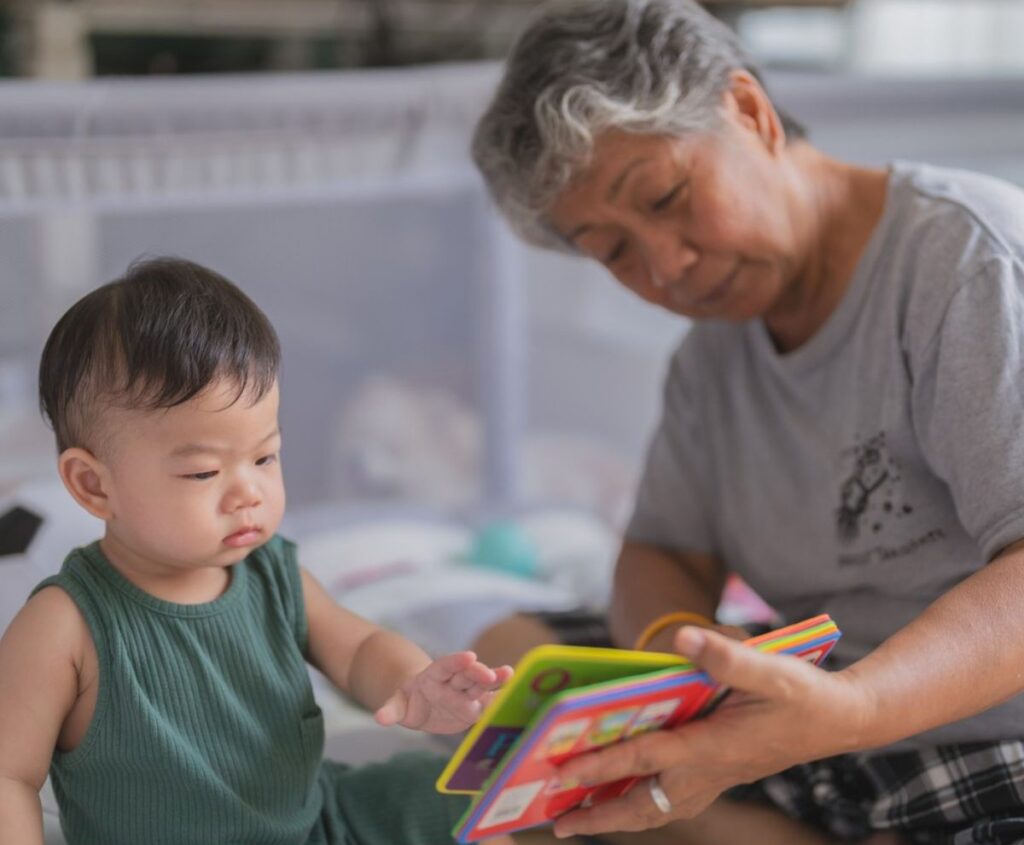
Books are a powerful tool for early communication. Some days your child may sit and listen to you read the whole story. Other days, they may want to flip pages and point at pictures. Both are valuable. Follow their lead and use the opportunity to label and describe what you see on each page.
Turn directions into a game
Practice listening skills through play. For example, hide items around the house and ask your child to find them and bring them back to you. Simple games like this help children practice understanding and following directions in a fun, low-pressure way.
Supporting Expressive Language (Communication)
Expressive language is how your child shares their thoughts, needs, and ideas. This can include sounds, gestures, words, or full sentences.
Simple ways to encourage communication:
Expand on what your child says
Build on your child’s words by modeling a slightly longer phrase.
- Child: “Doggy run”
- You: “Yes, the dog is running!”
This helps children hear how words fit together naturally.
Narrate everyday activities
Talk through what you’re doing during everyday activities. Adding sounds can also help connect words with actions.
For example:
- “I’m pouring the milk.”
- “The train is going—choo choo!”
Add extra details
When your child says something, add a little more information to keep the conversation going:
- Child: “Car go”
- You: “The car is going. The car is red.”
Everyday activities that build expressive language
Use playful activities like bubbles
Simple activities like blowing bubbles create natural opportunities for communication. One helpful strategy is waiting during key moments. Pausing gives your child a chance to communicate through words, gestures, sounds, or eye contact
For example:
- Hand your child the closed bubble container and wait for them to ask for help (through words, gestures, or eye contact)
- Say “Ready, set…” and wait for them to signal “go!”
- After the bubbles stop, pause again to encourage them to request more
By waiting, you give help children learn that communication has power and purpose.
Talk during bath time
Bath time is full of opportunities to introduce new words and concepts.
You can talk about:
- Wet and dry
- Hot and cold
- Fast and slow
- Up and down
It’s already part of your routine, which makes it a simple and natural time to build communication skills through play and conversation.
Building Language Through Connection
Communication skills grow through connection, repetition, play, and shared experiences, not through perfect lessons or flashcards.
By talking, playing, reading, narrating what you’re doing, and simply being present, you are already helping your child build the foundation for communication.
At the same time, every child develops at their own pace. If you have questions or concerns about your child’s communication, support is available. Early intervention services, like those offered through RMHS, can provide guidance and tools tailored to your child and family.
Connect with RMHS’ Early Intervention Programs
If you are a family living in Denver County and you have questions about your child’s communication or development, an evaluation can be a helpful first step.
Parents of children birth to age three anywhere in Colorado can contact Early Intervention Colorado to request an evaluation.
There are several ways to begin the evaluation process:
- Complete the online referral form
- Call 833-733-3734 (833-REFER-EI)
- Email: GetStartedwithEI@state.co.us
- Download the referral form and fax it to 303-866-5944
Families can also explore free RMHS classes designed to support children ages 5 and under. Classes focus on language development, transitioning to solid foods, and other early developmental skills.